Tuesday, May 20, 2014

Constructive Complexity, or Posthuman Ethics and Value Systems

George Carlin once asked, "If God loved you, how come He gave you tumors?"

Let's find out.
Table of Contents
I. Background
II. The Rectification of Names
III. The Danger of Wireheading
IV. Beyond Wireheading
V. And Then What Will They Do?
VI. Aren't They Kind of Bastards, These Posthumans?

Thursday, May 1, 2014

Things That I Like: What Homestuck and a random generator taught me about writing

This article originally appeared at The Oak Wheel on April 24, 2014. 
…

Or what a random generator taught me about writing, and Homestuck reinforced and Homestuck fanfiction prompted me to write about today.

Friday, April 25, 2014

Salt City Strangers [#1, #2]: The Good, the Bad, and the Ugly

A review for Salt City Strangers (#1 and #2). Credits at the end. 

Nutshell: The comic is about the latest incarnation of a team of superheroes defending Salt Lake City and, indeed, the whole world (because of Magic Stuff involving the transcontinental railroad that is actually kind of interesting). The series promises to deal with matters of faith (the Strangers range from Mormon-in-name-only to hardcore-believer) but has only barely begun to dip its toes in the water. Only time will tell if it can grow legs and live up to its potential.

Thursday, April 24, 2014

Sarcophagus: The Good, the Bad, and the Ugly


A review for Sarcophagus, by Philip Hemplow. 

Nutshell: In the shadow of Chernobyl, Dr. Victoria Cox is told, "a little vodka keeps away the radiation." Don't look for blood and gore or fast-paced thrills here; Sarcophagus moves slowly but inexorably like a Crawling Chaos. Some points are predictable, but they are skillfully set in order to lull you into complacency and keep you from realizing how it's all going to end. 

Thursday, April 10, 2014

What Hides Within: The Good, the Bad, and the Ugly

A review for What Hides Within, by Jason Parent. 

Nutshell: Jason Parent weaves a number of disparate storylines into a seamless whole. All loose ends are tied up by the end of the story, and in a way that makes you conflicted on whether it should be called bittersweet or a downer. You may struggle with tolerating Clive for awhile, but the story’s worth it.

Thursday, April 3, 2014

Things That I Like: You are about to read an article about second-person point of view

This article originally appeared at The Oak Wheel on March 27, 2014. 

…

As your eyes move from the title to the body of the article, you commence reading it. You quickly determine that the article is self-demonstrating, and you think that it’s kind of awkward. You hope that the author will cut it out with the crap.

I’ll acquiesce, dear reader. As the preceding self-demonstration mentioned, this article is about the second-person point of view, not self-demonstrating works. For that, you will want to read David Moser. I shall wait patiently till thou hast wetted thine appetite for self-demonstrating literature.

Are you back? Wonderful. As it happens I had a sudden attack of the King Jameses, as you may have noticed, so it was good to have a moment to handle that. You’re back, I’m back, we’re all back to back to back and we’re back to the actual article, alright?

Thank you.

Second-person point of view gets a bad rap most of the time. I don't think that I was ever told anything on it except "Don't." It took seeing other people disregard that rule, and a certain amount of contrarianism, for me to begin experimenting with it myself. Besides a whole lot of fanfiction, where it leads a very fulfilling life, however, it's still not quite yet in vogue in these modern times, the biggest example of it today probably being Andrew Hussie's Homestuck.

I'm a big fan of the second-person point of view now. I'm currently using it in The Buddha on the Road (which could possibly be described as "Andrew Hussie writes a sidequel to Herbert West: Re-Animator) and previously played with it in Sedatophobia, which is cast as a mostly-but-not-entirely one-sided discussion between the narrator and yourself, much like Lovecraft's Pickman's Model (what do we call these conversational blends of first- and second-person? first-point-five points of view?).

Second-person is not a gimmick, though. Like the choice between first-person and third-person, the decision to use the second-person shouldn't be made haphazardly. Melissa Tydell states that there are three benefits to using the second-person pov in her Write Practice article advocating, unusually, for writers to use it more often:

1) Second person pulls the reader into the action
2) Second person gets personal
3) Second person stretches your skills and surprises the reader

There's a reason that Choose Your Own Adventure books are generally in the second-person. For all the technical difficulty that it poses, it makes the action that much more real and penetrating. To grossly oversimplify the mechanisms at work, your sense of empathy is based on an ability to mirror others' emotions in yourself, asking "How would I feel under these circumstances?" By using the second-person point of view the line between yourself and the Other is blurred.

Consider this excerpt from the novelization of Star Wars: Revenge of the Sith, by Matthew Stover. For context, this takes place at the very end of the movie when Anakin has returned to consciousness and has found himself in the Vader armor. Read, and pay attention to how it makes you feel.
This is how it feels to be Anakin Skywalker, forever:
The first dawn of light in your universe brings pain.
The light burns you. It will always burn you. Part of you will always lie upon black glass sand beside a lake of fire while flames chew upon your flesh.
You can hear yourself breathing. It comes hard, and harsh, and it scrapes nerves already raw, but you cannot stop it. You can never stop it. You cannot even slow it down.
You don’t even have lungs anymore.
Do you have a good handle on your state of mind right now? Can you set it aside, acquire a couple of others, and pick it back up relatively unmarred? Good.

Let's read the same passage again, this time in the first-person point of view.
This is how it feels to be Anakin Skywalker, forever:
The first dawn of light in my universe brings pain.
The light burns me. It will always burn me. Part of me will always lie upon black glass sand beside a lake of fire while flames chew upon my flesh.
I can hear myself breathing. It comes hard, and harsh, and it scrapes nerves already raw, but I cannot stop it. I can never stop it. I cannot even slow it down.
I don’t even have lungs anymore.
And again, from the third-person:
This is how it feels to be Anakin Skywalker, forever:
The first dawn of light in his universe brings pain.
The light burns him. It will always burn him. Part of him will always lie upon black glass sand beside a lake of fire while flames chew upon his flesh.
He can hear himself breathing. It comes hard, and harsh, and it scrapes nerves already raw, but he cannot stop it. He can never stop it. He cannot even slow it down.
He doesn't even have lungs anymore.
If you're anything like me, the second-person point of view cuts to your heart more deeply than the other two do.

The second-person point of view also opens up the room to tricks that you can't utilize in quite the same way, if at all, in other points of view. Secret Life, which also uses the first- and third-person points of view in supplementary fashion, is able to hide important facts in the second-person that would be revealed much sooner, if not immediately, in either of the other possible points of view.

In Things Unsaid, one of the stories in my Babylonian Medley cycle, the narrative even turns a little meta through the use of the second-person. At the end, for example, the protagonist struggles to find the words to describe a particular incident which happened in xir past but fails and fails again. The reason for this is that the particulars of the incident are unknown to you, so of course you don't know the words to convey what really happened. By taking the state of mind of the reader and mirroring it in the protagonist, the line is blurred that much more.

Your turn: What are some unusual literary devices that you have used in the past or want to employ in the future?

R. Donald James Gauvreau works an assortment of odd jobs, most involving batteries. He has recently finished a guide to comparative mythology for worldbuilders, available here for free. He also maintains a blog at White Marble Block, where he regularly posts story ideas and free fiction.

Monday, March 31, 2014

Productivity Report Mar 17-30

Oh my gosh, I don't even know anymore.

I can barely remember what's been going on. Like. Things.

Things have been going on. They have been  going on all over the place.

Lots of posts backlogged. I've read two stories and written reviews for them. Those reviews should be appearing over the next few weeks. Here, White Marble Block, and The Oak Wheel. Also appeared at Goodreads and Smashwords. Need to fix my problem with Amazon so they can appear there too.

Got a couple of issues of comics to review, and then the author of one of the books I reviewed may be sending me another book or two. So that's good.

Building contacts, reading books and feeling productive, yeah. Yeah.

Things. Going on.

I've gotten established on Ficwad. Archive of Our Own. Tumblr, too.

Everything's happening on the Twitter, lords and ladies. Everything.

So many followers. So few that aren't spam.

I've stopped auto-following. I was told to follow anyone who followed me but I'm going to follow just the ones who seem relevant to writing. Twenty million followers don't mean anything when they don't pay attention to your tweets.

Going on.

Getting established on Dreamwidth. May be getting established on LiveJournal, but that's a trip for another month. Not doing it tomorrow. No way, nuh uh.

Good amount of outlines finished up. Should go well. Won't be twenty even by the end of tomorrow but hey hey hey, that's alright. I'll get it done. Without prepped outlines I was able to do well last month anyway.

We'll figure it out.

So many things.

But it's getting easier and easier, smoother and smoother, yeah? Yeah.

Yeah.

I don't even know anymore...

Thursday, March 20, 2014

Things That I Like: Some ways to draw out a fight scene

This article originally appeared at The Oak Wheel on March 13, 2014. 

…

In my last post on the Oak Wheel I established a problem with fight scenes, namely that the longer they are the more unrealistic they become. Like any good problem it’s a solvable one, and I’d like to suggest some possibilities. A lot of these will draw on examples from my own writing because, after all, other people may know us better than we know ourselves but we don’t know anybody better than we know ourselves (at least, we shouldn’t, but luminosity is a discussion for another day). I don’t expect all of them to be immediately applicable to your story but hopefully they should be able to give you some ideas.

There are a few different things that I’ve done. The first one is make both parties very, very skilled but just as lucky. This is very contrived, and I don’t think that I’ve ever managed to do it well, but in the right hands I think it’s possible. I don’t think that it’d be possible to do more than once a decade, let alone more than once a book, though.

Another possibility is disregarding some of the other shortness advice and zeroing in on every detail. Second to second, what is being felt, physically and mentally? Give us the panic, give us the adrenaline, give us the waves of pain from a broken rib, and the will that keeps someone moving despite internal bleeding. Lavish us with it as if we’re watching the scene in bullet time with an MMA commentator. Take the sensory detail and stab us in the heart with it.

It won’t work every time, but it’s possible.

For SF writers there are a few more options. In one story, maybe i’m just tired, people like the main character couldn’t die until they lost the mental strength to keep regenerating. Battles between such beings were long, hard slogs that were as psychological as they were physical, fought with the intent to stab, crush, beat, and chop the limbs off your opponent until the pain and the effort of regenerating were too great to summon the strength to heal themselves anymore. In fact, pure psychological attacks (such as when another character was taunted about her mother’s death, which she hadn’t known about until then) could be as deadly as anything else if they made it harder for your opponent to find the mental strength to keep going.

Similar to this, The Buddha on the Road features characters who, by dint of being zombies, are trying to make each other nonfunctional rather than, um, dead. Brain trauma matters to them as little as torn jugular veins (well, maybe a little bit more, but not by much), so the intent of each one is to take the other guy down into so many pieces that he’s no longer a threat. Both of these ideas are pretty similar to each other (i.e. characters with superhuman toughness) but the details are enough to make them and their fights distinct from each other. Whether you take these mechanics or come up with your own spin on superhuman toughness it should still result in something that smells fresh.

Fighting on some other plane is also great stuff. In Lost Girl the actual physical combat is presented but ultimately takes a backseat to the real conflict being fought between the two characters as they wield a kind of story magic against each other. Each one of them was trying to fit themselves and the other character into a particular archetypal story where their victory was inevitable, nay, required, and drew on incidental details to force the other character to fit the role that had been chosen for them.

This brings up magic in general. Perhaps there are enchantments at work which must be penetrated or used up before anyone can actually be hurt. Something like a mix of this and maybe i’m just tired was done in Her Body Moves, whose characters benefited from a regeneration system that can be overtaxed by suffering too much over too small a span of time. Or they have but one weakness which must be exploited in order to kill them (remember, one of the reasons that real fights end so quickly is because there are so many ways to kill a person).

Before you start to figure out how to justify a long fight scene, though, make sure that you should. Is it something that you can write well? Do you even need it? Many times the tension in the build-up to the fight, and even the aftermath, can be more interesting than the fight itself. Like everything else, you should only bother with a long fight scene when it’s going to serve the story to begin with. And most importantly of all, don’t forget the implications: Your justification, whether it could only exist in a fantasy novel or actually does have some realism to it, will undoubtedly have an effect on the rest of the story and its world. Even zeroing in and slowing down, as described in the third paragraph, will at least have an effect on the style of the rest of the story, which needs to be one that this technique can reasonably fit into and complement.

Your turn: How do you handle action scenes?

R. Donald James Gauvreau works an assortment of odd jobs, most involving batteries. He has recently finished a guide to comparative mythology for worldbuilders, available here for free. He also maintains a blog at White Marble Block, where he regularly posts story ideas and free fiction.

Sunday, March 16, 2014

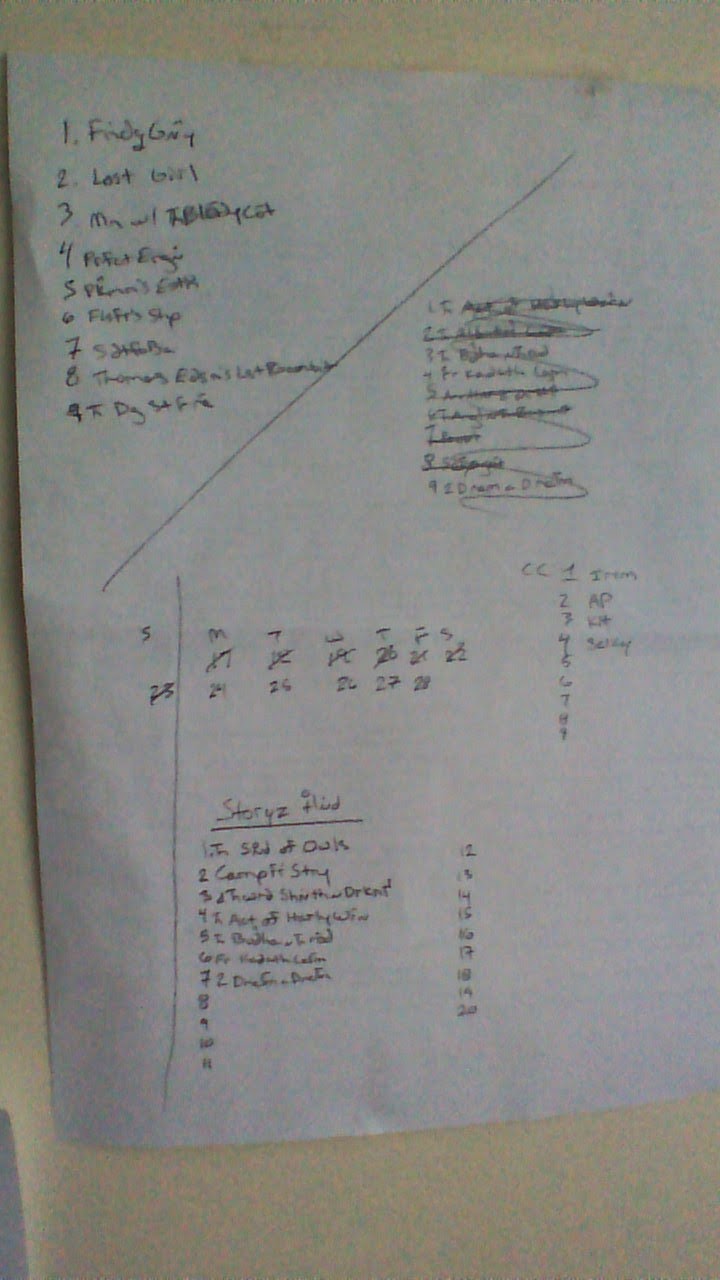
A glimpse of the wall of doom

I have begun to post an ever-increasing amount of pages on the wall where I generally write, in order to easily access information without tying up my hands. One of the downsides to putting your computer on a stand barely bigger than your laptop is that there's nowhere else to put papers.

I imagine that I'll be adding yet more pages in times to come.

This is the list that I printed off to keep track of what I needed to do in my off/prep-month. "Vocab?" is in reference to the idea of printing off a sheet or two of words that I want to add to my vocabulary or that I think might be useful in a particular situation. 

As you can see I'm continually making notes, rearranging when something's getting done, etc. If something is circled then that means that it's not a high priority and doesn't necessarily have to get done this month. 

This is the sheet that I made use of while I was working on some of the articles for the Culture Column. Now that I took the pictures, in accordance with the note at the bottom of the page, I guess it's time to retire the page to free up space for more important things. 

The on/crazy-month's counterpart to the first page, I suppose. Going top to bottom, left to right: The first list (1-9, Finding Ginny, etc) listed the stories that I had already completed by the time that I first made this list. The second list (1-9, all scribbled out) is the list of stories that I was working on in order to hit fifteen stories. The third list (1-9, Irem, etc) is a list of culture column articles that I was planning. The to-do list made that obsolete. The mini-calendar to the left kept me aware of how many days were left until the end of the month. As you can see I didn't always check the days off. The last list, titled "Stories Outlined," is keeping track of the stories that I have outlined in preparation for the coming on/crazy-month. I aim to have twenty outlines, as you can see. 


Productivity Report

Did pretty well this past week, all things considered. Only 47 poems submitted, but that's alright. Also didn't expand the card catalog, but this weeks submissions showed that I actually have a large enough selection for now. I don't really need another twenty non-paying markets in the list just yet and I've got most, if not all, of the professional rate markets.

The blog is filled out for stories up through the first full week of April. I may or may not write another one. By the end of today [writing on Saturday] I should have gotten an idea of which stories I'm going to be outlining over the next two weeks.

Besides the tasks written out at the beginning of the week I also got two shiny published stories to review. I should have the first book finished and reviewed by the end of the month. I've also begun planning a little bit for a Lovecraftian toolkit PDF for gaming and writing, getting the basic structure figured out and asking people at RPG.net what they'd like to see.

This coming week it's looking like:

  • Monday: Create three Useful Notes PDFs and the So You Want To PDF. Shoot an email to see if they'd mind me putting a link up on TV Tropes to the PDFs. Write So You Want To Write the Next HPMOR and shoot it to Eliezer Yudkowsky for props or anti-props, as the case may be. 
  • Tuesday: Do a little more uploading of fanfiction (ficwad, etc). Restructure White Marble Block. Clean out the bookmarks. Clean out my files a little more. 
  • Wednesday: Clean out email account. A story outline. Flesh out some fanfic seeds (a paragraph where there is none, doubled length where there is). After all that's done and I've read some stories for review purposes, see how much I can do on the Unlikely outline. It'd be great if I could get the outline down pat enough that, come next off/prep-month, I can take a five-day to sit down (or stand, as the case may be) and churn out 20-25,000 words and get it all done then. Assuming I update it every week and every other week includes an additional story, that's eleven weeks (22 chapters total) that have their stories taken care of. 
  • Thursday: One or two Culture Column articles. A story outline, possibly but not probably. 
  • Friday: Arrange for guest posts for White Marble Block. One or two story outlines. 
  • Saturday: Take a day off to heal. 
Scattered throughout, I'll also be reading and reviewing all sorts of stories, some on Absolute Write and at least one of the published stories that was sent to me. 

Monday, March 10, 2014

The Commercial Curmudgeon: The Sad Demise of the "History" Channel

Keep in mind the soul of your story as you're writing it. Whether it's while you're still working on the original product or writing the fifth sequel, don't sell its soul just to play things safe. Unless that was what you were intending to do all along, of course. But if it's got a soul to start with then make sure that it's still got one at the end.


The Commercial Curmudgeon: The Sad Demise of the "History" Channel: I love history. When I was a kid, I'd spend hours poring over old history textbooks, looking for maps, graphs and charts and reading ...